Overview
The China Pakistan Cultural and Commercial Consortium — CPCCC — is envisioned as a cooperation platform dedicated to strengthening cultural, commercial, educational, institutional, industrial, technological, tourism, media, research, and people-to-people linkages between China and Pakistan.
CPCCC aims to provide an organized mechanism for connecting relevant stakeholders from both countries, including enterprises, investors, chambers of commerce, universities, cultural bodies, creative economy platforms, media organizations, tourism stakeholders, think tanks, professional networks, youth groups, women entrepreneurs, and development-oriented institutions.
The Consortium is built on the understanding that meaningful economic cooperation requires a strong foundation of cultural trust, communication, institutional credibility, and people-to-people understanding. For this reason, CPCCC gives equal importance to cultural diplomacy and commercial facilitation.
Stakeholder Focus
Connecting enterprises, universities, cultural bodies, investors, and professionals from both China and Pakistan.
Dual Purpose
Equal emphasis on cultural diplomacy and commercial facilitation for sustainable outcomes.
Platform Model
An organized mechanism for structured cooperation, not a regulatory or governmental body.
Logo Rationale
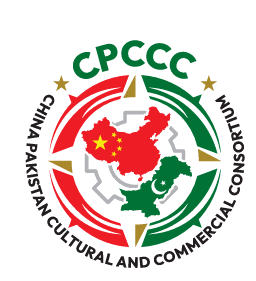
The logo for the China Pakistan Cultural and Commercial Consortium (CPCCC) integrates national identity and strategic partnership by featuring the geographical maps of China and Pakistan—bearing their respective flag motifs—encircled by a grey gear to symbolize industrial synergy, trade, and economic collaboration. Framed by a dynamic red and green circular ring representing bilateral connection, four compass points to signal strategic direction, and gold stars honoring excellence, the design unifies the primary national colors of both countries to reflect a shared vision of cultural and commercial unity.
Vision & Mission
To become a trusted China-Pakistan cooperation platform that connects cultures, enables commerce, promotes knowledge exchange, facilitates investment, strengthens logistics connectivity, and builds long-term people-to-people friendship.
To facilitate structured cooperation between China and Pakistan by promoting cultural exchange, business linkages, investment facilitation, educational collaboration, research cooperation, creative economy development, media engagement, tourism promotion, logistics connectivity, and sectoral partnerships.
CPCCC seeks to serve as a bridge between institutions and enterprises, between culture and commerce, and between opportunity and implementation.
Objectives
CPCCC's objectives are to:
Promote cultural understanding and people-to-people connectivity between China and Pakistan.
Facilitate commercial cooperation, trade linkages, investment opportunities, and business matchmaking.
Support Chinese investors and enterprises seeking credible opportunities in Pakistan.
Connect Pakistani enterprises, institutions, and products with relevant Chinese partners and platforms.
Promote cultural festivals, heritage dialogue, creative economy partnerships, tourism linkages, and media cooperation.
Facilitate educational exchange, scholarships, university collaboration, research programs, skills development, and youth connectivity.
Support cooperation in logistics, warehousing, industrial parks, agriculture, minerals, energy, technology, tourism, and other priority sectors.
Develop a reliable institutional bridge for long-term China-Pakistan cooperation.
Our Principles
CPCCC is guided by mutual respect, transparency, professionalism, cultural sensitivity, inclusiveness, compliance with applicable laws, institutional integrity, shared prosperity, and responsible cooperation.
The Consortium is non-political, development-oriented, and committed to strengthening the positive relationship between China and Pakistan through practical and ethical engagement.
Mutual Respect
Equal regard for the cultures, institutions, and values of both nations.
Transparency
Open and accountable processes in all cooperation activities.
Professionalism
High standards in all engagements, documentation, and communications.
Inclusiveness
Welcoming diverse stakeholders including youth, women, and marginalized communities.
Responsible Cooperation
Ethical engagement with environmental and social responsibility.
Non-Political
Development-oriented focus independent of political affiliations.
Institutional Framework
CPCCC may operate through dedicated desks, working groups, advisory panels, and sectoral coordination units. These may include cultural cooperation, commercial facilitation, logistics hub development, education and research, media and public diplomacy, tourism and heritage, industrial cooperation, agriculture, technology, youth engagement, and policy research.
This structure allows CPCCC to respond to the diverse nature of China-Pakistan cooperation while maintaining professional coordination and accountability.
Governance & Secretariat
The CPCCC Secretariat is expected to function as the coordination center for programs, partnerships, stakeholder engagement, documentation, communication, and implementation follow-up. The governance structure may include an advisory board, executive leadership, sectoral experts, program coordinators, and institutional partners.
Patronage / Advisory Support
Executive Leadership
Secretariat
Sectoral Desks
Working Groups
Country Coordination
Partner Institutions
China-Pakistan Context
China and Pakistan share a relationship built on trust, strategic cooperation, regional connectivity, economic partnership, and people-to-people goodwill. The Belt and Road Initiative and the China-Pakistan Economic Corridor have opened new possibilities for trade, investment, logistics, industrial cooperation, education, technology, and cultural exchange.
CPCCC seeks to complement this broader relationship by providing a practical platform for institutions, enterprises, professionals, youth, cultural organizations, and development stakeholders.
Legal & Compliance Statement
CPCCC operates as a cooperation and facilitation platform subject to applicable laws, rules, regulations, registration requirements, and regulatory approvals in the relevant jurisdictions.
CPCCC does not claim to represent any government, embassy, ministry, regulatory authority, or public institution unless expressly authorized in writing by the competent authority. All commercial transactions, investment decisions, financial commitments, partnerships, and project agreements remain subject to separate legal documentation and due diligence by the concerned parties.